01
Data provenance
Point-in-time inputs, date coverage, revisions, survivorship, and reproducibility.
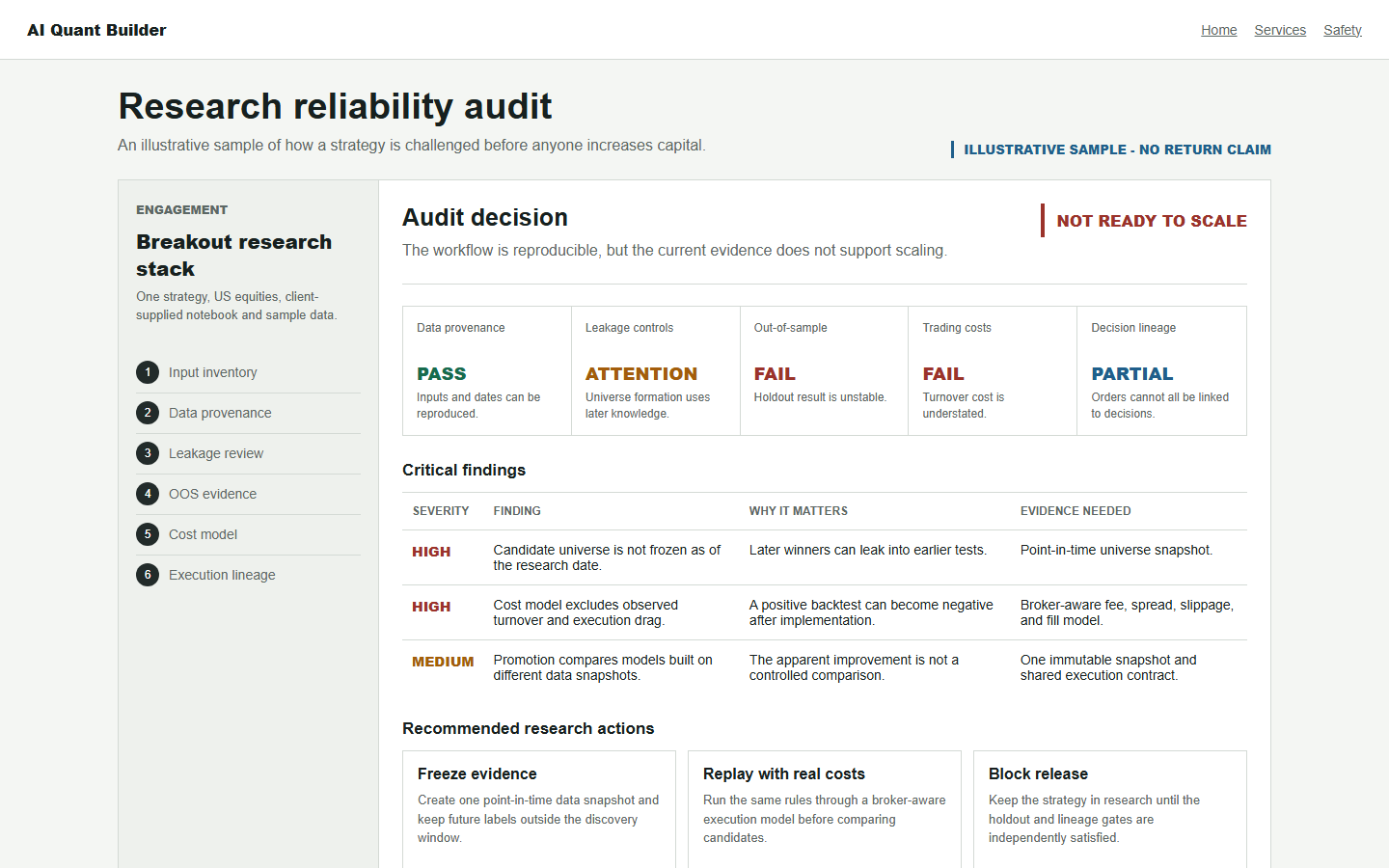
Find the data, leakage, cost, promotion, and execution flaws that make a backtest look better than the strategy really is.
Bring an existing strategy, notebook, repository, or research report. The audit tests whether its evidence and execution path are trustworthy enough for the next research decision.
Point-in-time inputs, date coverage, revisions, survivorship, and reproducibility.
Future information, winner-first selection, label leakage, duplicate windows, and post-hoc rules.
Frozen rules, honest holdouts, walk-forward design, robustness, and outlier dependence.
Turnover, fees, spread, slippage, liquidity, integer quantities, and transition cost.
Comparable snapshots, promotion criteria, challenger evidence, and release gates.
Decision-to-order-to-fill traceability, idempotency, reconciliation, and PnL attribution.
Introductory service pricing. Scope, inputs, confidentiality, and acceptance criteria are agreed before payment.
Send a public-safe description of the strategy format, market, data source, and the reliability question you need answered.